
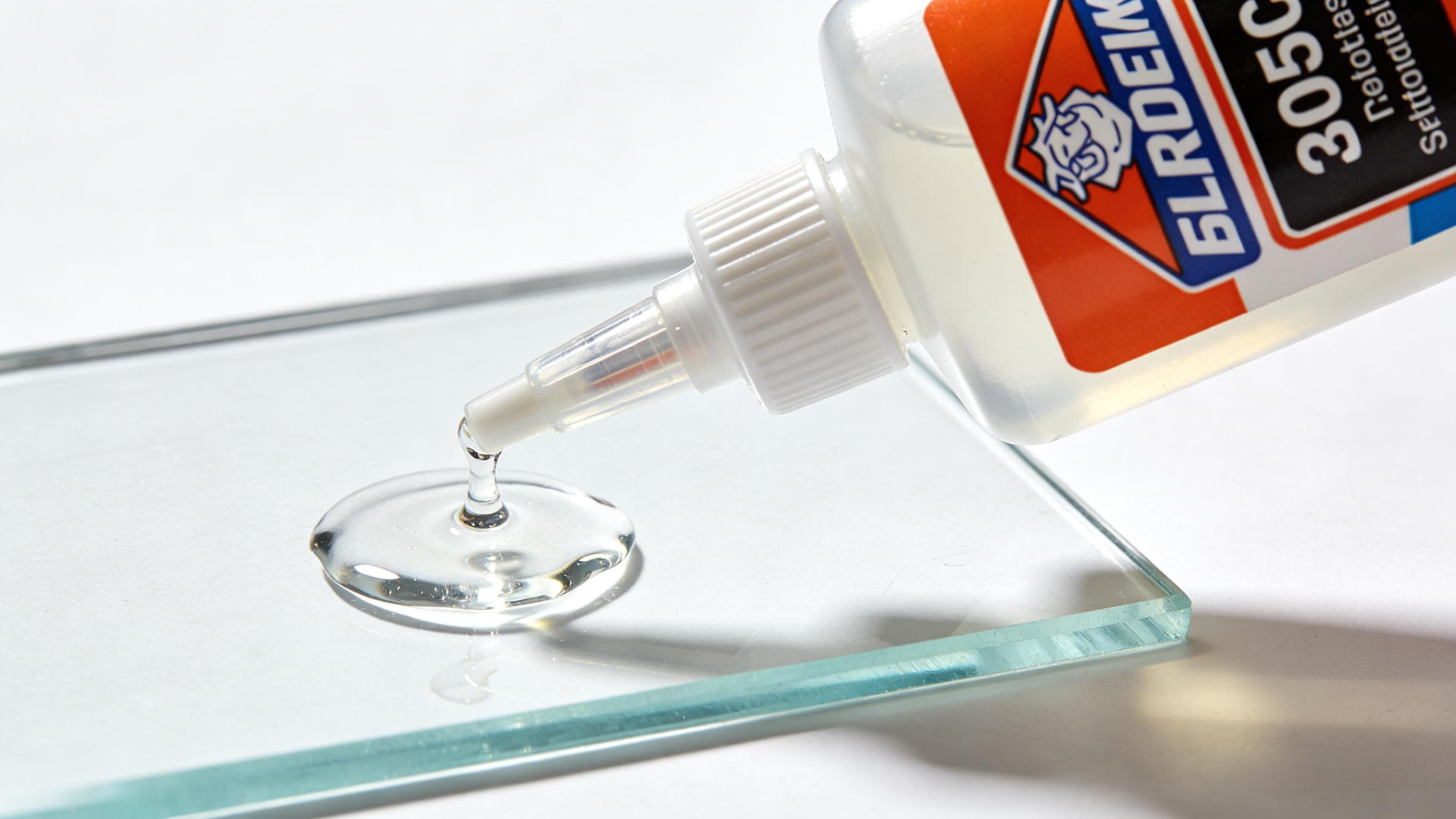
Most adhesive failures are not failures of the adhesive but of the bond between adhesive and substrate, and moisture is usually what finds the weak point. Silanes address that interface directly: their silanol groups bond to glass, metal and mineral surfaces, and their organic group reacts into the adhesive. In silicone sealants they also do the curing, and in silicone pressure-sensitive adhesives MQ resins provide the tack.
Adhesion promoters
Added to the formulation or applied as a primer, a silane adhesion promoter makes the bond chemical and water-resistant. Amino silanes suit epoxy, polyurethane, phenolic and RTV silicone systems; epoxy silanes suit epoxy, polysulfide and polyurethane, and the epoxycyclohexyl grade gives storage-stable, non-yellowing adhesion. Mercapto silanes improve the adhesion of polysulfide and polyurethane sealants to glass and metal. Oligomeric amino and epoxy silanes are less volatile and release less alcohol, which makes them easier to compound.
Crosslinkers and moisture scavengers
Moisture-curing sealants — silicone, silane-terminated polyether (MS polymer) and silylated polyurethane — cure through hydrolysable silicon groups. Alkoxy silanes and orthosilicates act as crosslinkers, while vinyl silanes scavenge moisture in the package so the sealant does not cure in the cartridge.
Silicone pressure-sensitive adhesives
MQ resins are the tackifiers of silicone PSAs: blended with silicone gum, they set the balance of tack, peel and cohesion. Silicone PSAs keep their adhesion from very low to very high temperatures and bond to low-surface-energy substrates, which is why they are used on tapes for electronics and high-temperature masking.
Choosing an adhesion promoter
- Match the organic group to the adhesive chemistry — amino for epoxy and urethane, epoxy for epoxy and polysulfide, mercapto for polysulfide and urethane sealants.
- Additive or primer. As an additive it is used at a fraction of a percent up to about 1% of the formulation; as a primer, it is applied dilute to the substrate first.
- Shelf life. In one-part systems, check that the silane is compatible with the package; ureido and oligomeric grades are chosen where stability matters.
For a recommendation for your formulation, a COA, an SDS or a quotation, contact our technical sales team.
관련 제품
Silanes
SF-S550 γ-Aminopropyltriethoxysilane
CAS 919-30-2
γ-Aminopropyltriethoxysilane; 3-Aminopropyltriethoxysilane; gamma-Aminopropyltriethoxysilane CAS No. 919-30-2
Silanes
SF-S792 N-[3-(Trimethoxysilyl)propyl]ethylenediamine
CAS 1760-24-3
N-[3-(Trimethoxysilyl)propyl]ethylenediamine; N-β-(Aminoethyl)- γ-aminopropyltrimethoxysilane; N-2-(Aminoethyl)- 3-aminopropyltrimethoxysilane CAS No. 1760-24-3
Silanes
SF-S1146 Bisaminosilane polymer
Bisaminosilane polymer; Diaminofunctional silane; Oligomeric diamino silane
Silanes
SF-S560 3-Glycidoxypropyl(trimethoxysilane)
CAS 2530-83-8
γ-(2,3-epoxypropoxy)propyltrimethoxysilane; 3-(2,3-epoxypropoxy)propyltrimethoxysilane; 3-Glycidoxypropyl(trimethoxysilane) CAS No. 2530-83-8
Silanes
SF-S1861 2-(3,4-Epoxycyclohexyl)ethyltriethoxysilane
CAS 10217-34-2
2-(3,4-Epoxycyclohexyl)ethyltriethoxysilane CAS No. 10217-34-2
Silanes
SF-SMP200 Epoxy silane oligomer
Epoxy silane oligomer
Silanes
SF-S591 3-Mercaptopropyltriethoxysilane
CAS 14814-09-6
γ-Mercaptopropyltriethoxysilane, CAS No.14814-09-6
Silanes
SF-S320 3-Ureapropyltriethoxysilane solution
3-Ureapropyltriethoxysilane (50% methanol solution)
Silanes
SF-S621 Vinylmethyldimethoxysilane
CAS 16753-62-1
Vinylmethyldimethoxysilane CAS No. 16753-62-1
Silanes
SF-S430 Tetrapropoxysilane
CAS 682-01-9
Tetrapropoxysilane; Tetra n-Propyl Silicate CAS No. 682-01-9
MQ Silicone Resins
SF-201B Methyl MQ silicone resin
CAS 68988-56-7
Methyl MQ silicone resin
MQ Silicone Resins
SF-101 Methylvinyl MQ silicone resins
CAS 68988-89-6
Methylvinyl MQ silicone resin