
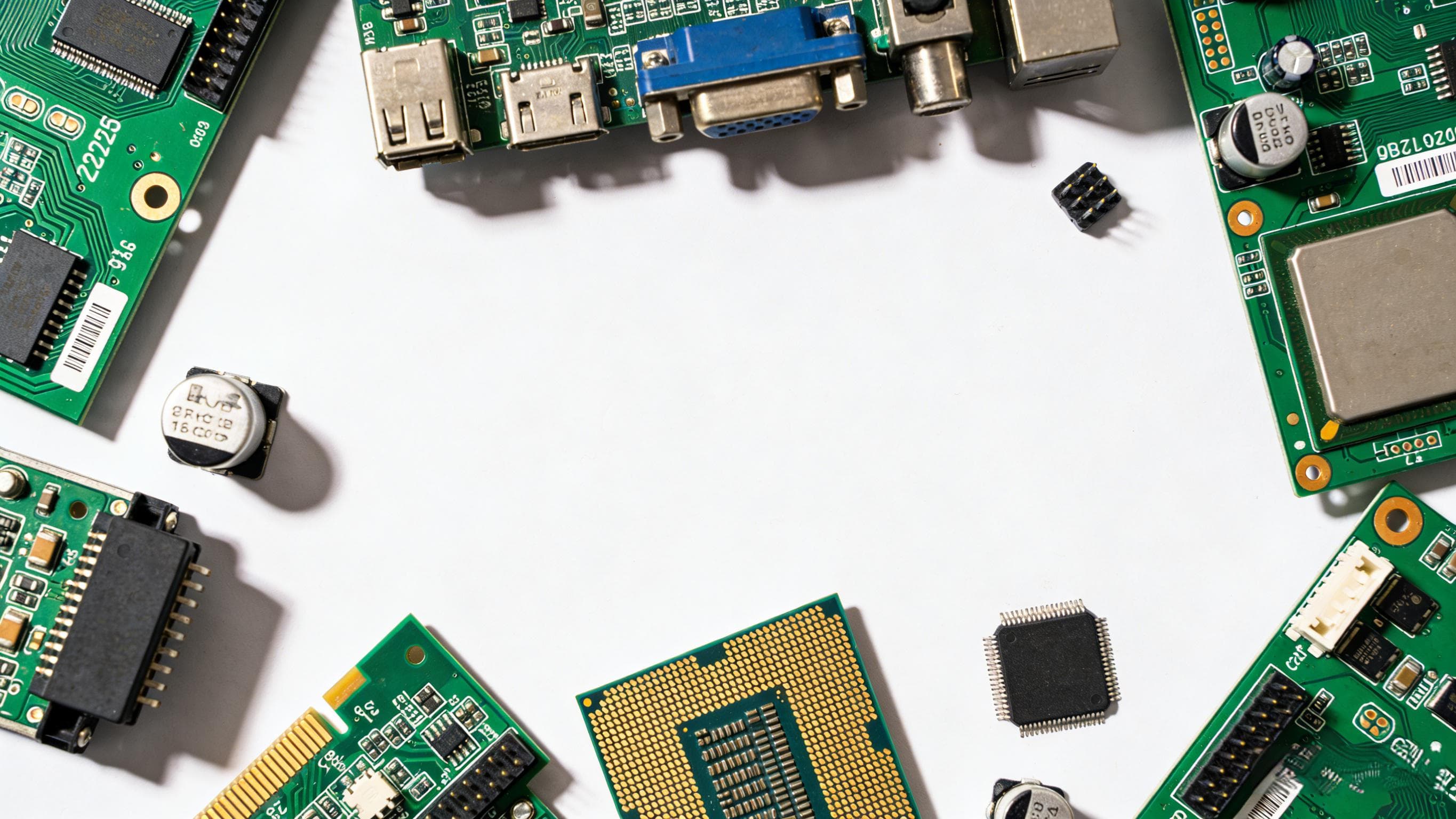
Electronics ask for materials that insulate, protect and stay stable for years in a small space that gets hot. Silicon chemistry appears at almost every stage: in the wafer fab as adhesion promoters and deposition precursors, in packaging as coupling agents for epoxy encapsulants, and on the finished board as protective coatings and silicone potting.
Protective coatings for boards and components
Fluorosilane coatings form a film only a few micrometres thick — or a single molecule thick — that repels water, oil and corrosive gases without affecting electrical contact. They are applied by dipping or spraying to circuit board assemblies, connectors and sensors.
Encapsulants and circuit boards
Epoxy encapsulants, sealants and laminates are filled with silica and glass. Epoxy silanes bond that filler into the resin, which improves strength and, more importantly, keeps the electrical properties from degrading when moisture reaches the interface.
Wafer processing
Hexamethyldisilazane primes wafers so photoresist adheres, and tetramethyldivinyldisilazane serves as a tackifier for negative photoresists. High-purity tetraethyl orthosilicate is a precursor for silicon dioxide films by chemical vapour deposition. Methacryloxypropyl POSS is used in UV-curable and photoresist formulations for fine circuitry.
Potting, gels and dielectric fluids
Silicone potting compounds and gels protect components from moisture, vibration and heat. Hydroxyl-terminated fluids are the base of condensation-cure potting; vinyl fluids and electronic-grade methylhydrogen fluids are the base and crosslinker of addition-cure systems, including thermally conductive grades. Silicone and phenyl silicone fluids serve as dielectric fluids in capacitors and transformers, and silicone resin powders diffuse light in LED covers.
What to check
- Purity and ionic content, for anything that touches a wafer or a live circuit.
- Low-molecular-weight siloxanes, which can migrate and contaminate contacts; low-cyclic grades are chosen for electronics.
- Cure by-products, which should not corrode copper or silver.
For a recommendation for your formulation, a COA, an SDS or a quotation, contact our technical sales team.
관련 제품
Others
SF-C420 Electronic Grade Coating
fluoro-Electronic-Grade-Coating
Silanes
SF-S903 1H,1H,2H,2H-Perfluorodecyltrimethoxysilane
CAS 83048-65-1
1H,1H,2H,2H-Perfluorodecyltrimethoxysilane; 1H,1H,2H,2H-Heptadecafluorodecyltrimethoxysilane CAS No. 83048-65-1
Silanes
SF-S1861 2-(3,4-Epoxycyclohexyl)ethyltriethoxysilane
CAS 10217-34-2
2-(3,4-Epoxycyclohexyl)ethyltriethoxysilane CAS No. 10217-34-2
Silanes
SF-S560 3-Glycidoxypropyl(trimethoxysilane)
CAS 2530-83-8
γ-(2,3-epoxypropoxy)propyltrimethoxysilane; 3-(2,3-epoxypropoxy)propyltrimethoxysilane; 3-Glycidoxypropyl(trimethoxysilane) CAS No. 2530-83-8
Siloxanes & Silazanes
SF-SN62 Hexamethyldisilazane
CAS 999-97-3
Hexamethyldisilazane; 1,1,1,3,3,3-hexamethyldisilazane; HMDS CAS No. 999-97-3
Siloxanes & Silazanes
SF-SN42 Tetramethyldivinyldisilazane
CAS 7691-02-3
1,3-Divinyl-1,1,3,3-tetramethyldisilazane; Tetramethyldivinyldisilazane (VMN) CAS No. 7691-02-3
Silanes
SF-S028 Tetraethylsilicate, TEOS
CAS 78-10-4
Tetraethyl orthosilicate; Tetraethoxysilane; Tetraethylsilicate; TEOS CAS No. 78-10-4
MQ Silicone Resins
SF-POSS240 Methacryloxypropyl POSS
CAS 160185-24-0
Nanoscale cage-like polyhedral oligomeric silsesquioxane
Silicone Oils
SF-LH201 Hydrogen silicone oil
low-cyclic electronic-grade methylhydrosiloxane oil (dimethylmethylhydrosiloxane copolymer)
Silicone Oils
SF-QT200 OH end-blocked polydimethylsiloxane
CAS 70131-67-8
Silanol fluid; silicone fluid; OH end-blocked polydimethylsiloxane; 107 polymer; Hydroxy silicone oil CAS No. 70131-67-8
Silicone Oils
SF-MV200 Mono terminated vinyl silicone oil
CAS 68952-00-1, 68951-99-5
Single end-capped vinyl silicone oil; Mono terminated vinyl silicone oil; vinyl silicone fluid
MQ Silicone Resins
SF-152 Spherical silicone resin
CAS 68554-70-1
Polymethylsilsesquioxane (spherical silicone resin) micro powder is a kind of polymethylsilsesquioxane produced by hydrolysis and polymerization of organosilicone as raw material. It is a spherical micron-sized silicone resin powder, also known as silicone microspheres.